
Retired, Replaced, and Why
Tento obsah zatím není dostupný ve vašem jazyce.
Module 7 of 8 in the chapter The Story of Integration: From CORBA to Today, chapter 17 of the Integration Architect course. Each module stands on its own. Previous: Salesforce Legacy You’ll Still Meet · Next: Retiring Your Own, and What Comes Next
The question this module answers: Of everything in this story, what has actually ended, or has an end date? And why did each one go, in the words of whoever ended it?
Not Just the Current
Section titled “Not Just the Current”When we planned this course, I said: let’s not just tell the current. Let’s mention the past, and why past mechanisms were phased out.
This module does that, in one place. Every row is something that has been retired, or has a date when it will be. For each one: when it went, why, in the words of whoever retired it (Salesforce, or the standard), and what replaced it. The earlier modules tell each story. This is the list you can come back to.
And as you read it, look at the “why”. It isn’t always security.
Retired for Security
Section titled “Retired for Security”Most of the recent retirements are here. Something was safe enough for its time, and then it wasn’t, or a safer way arrived (chapter 13 module 1 tells this part of the story in full).
| Mechanism | Arrived | Ended | Why, in its own words | Replaced by |
|---|---|---|---|---|
| Plain FTP | 1985 | Being replaced across the industry, no single date | “Standard FTP… sends passwords in clear text” (RFC 2577 (opens in a new tab), IETF, 1999) | SFTP, or FTPS (module 2) |
| TLS 1.0 | 1999 | Off at Salesforce March 4, 2017; retired by the standard 2021 | “TLS 1.0 MUST NOT be used” (RFC 8996 (opens in a new tab), IETF, 2021) | TLS 1.2 and 1.3 |
| Session IDs in outbound messages | With outbound messages, Winter ‘07 | February 23, 2026 | “To align with modern security best practices” | The listener calls back with its own OAuth token (chapter 9 module 7) |
| Legacy named credentials | Spring ‘15 | Deprecated since Winter ‘23 | The new kind is “extensible, customizable, and more secure” | Named credentials with external credentials (chapter 4 module 1) |
| OAuth username-password flow | Early OAuth | February 20, 2027 | “directly passes the user’s credentials in HTTP requests, which presents security risks” | The client credentials or JWT bearer flow (chapter 13 module 5) |
| OAuth user-agent and hybrid user-agent flows | Early OAuth | February 20, 2027 | “insecure because they directly expose access tokens to the browser” | The web server flow with PKCE (chapter 13 module 5) |
| Cross-org adapter legacy authentication | With the cross-org adapter | OAuth 2.0 password-based method: Spring ‘27 (February 20, 2027); password authentication through SOAP login(): Summer ‘27 (Salesforce Help (opens in a new tab)) | The password and OAuth methods “rely on the SOAP login() call, which is being retired” (Winter ‘27 release notes (opens in a new tab)) | Named credentials, “a more robust and secure authentication method” (chapter 19 module 1) |
SOAP API login() | 2003 | Summer ‘27 (versions 31.0 to 64.0) | “SOAP API login() does not provide that posture and is being retired” | OAuth with External Client Apps (chapter 10 module 3) |
| Connected apps | Spring ‘13 | No new ones since Spring ‘26; end of support Summer ‘27 | External Client Apps “use a default-closed security posture” | External Client Apps (chapter 13 module 6) |
Read the quotes, and the reasons are specific. The password travelled in clear text. The old encryption lacked current algorithms. A ready-made key sat inside a message. A real user’s password had to be held by a program. A token was exposed to the browser. And one retirement pulls others with it: when login() goes, everything that signs in through it has to move. None of these was a mistake when it was built. The ground moved.
Your own org shows the same dates, as tasks. In Setup, Release Updates lists the ones that need action, each with its deadline. Here are two of this table’s rows, as a Developer Edition org showed them.
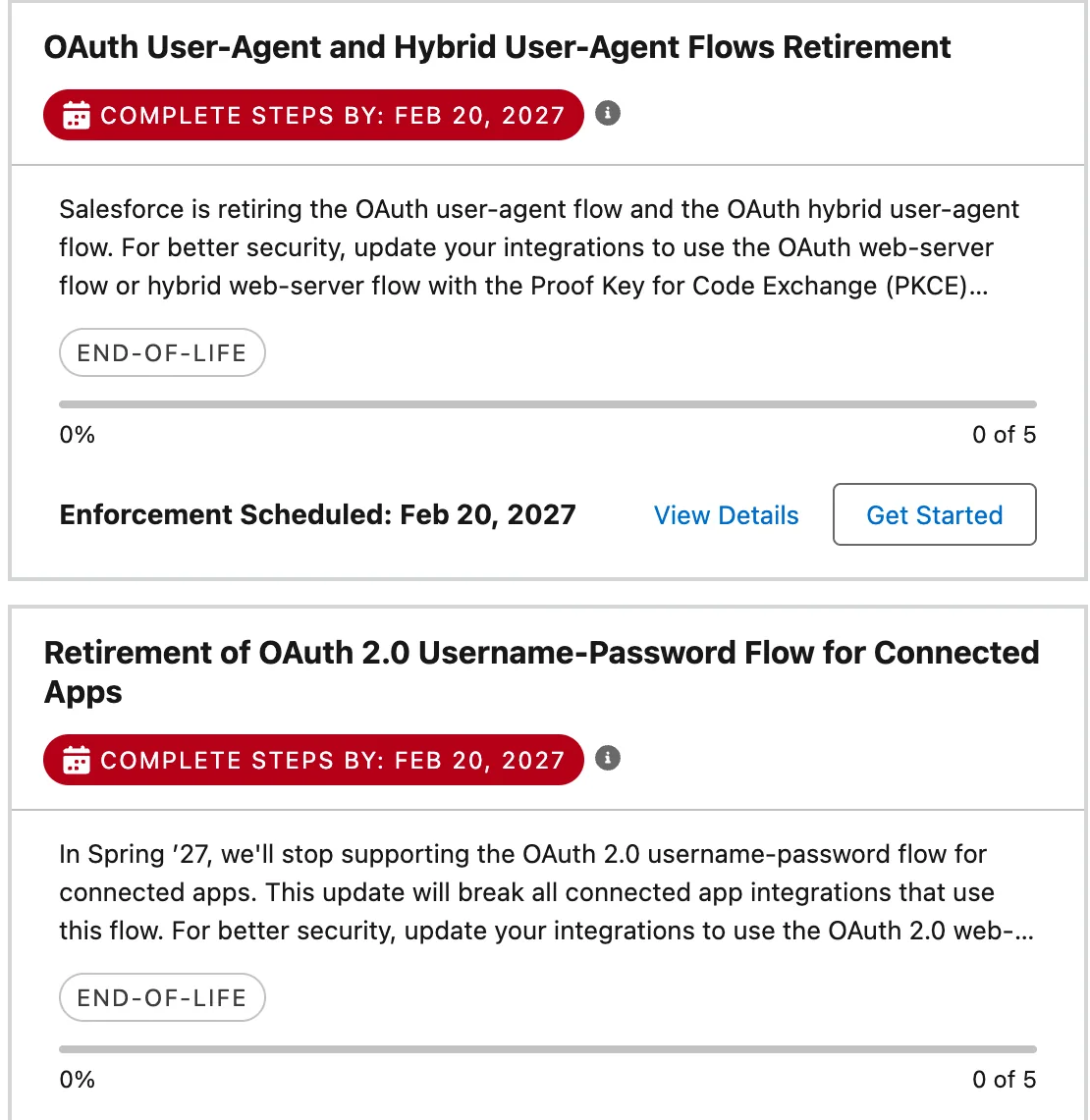
Two of the retirements in this module, as release updates with a deadline (Salesforce, Setup in a Developer Edition org, screenshot, November 2026). Full size
Retired Because Something Better Took Over
Section titled “Retired Because Something Better Took Over”These didn’t go because they were unsafe. The world moved, or a better way arrived and the old one stopped being worth keeping.
| Mechanism | Arrived | Ended | Why | Replaced by |
|---|---|---|---|---|
| NetWare’s IPX/SPX | 1983 | Last NetWare release 2009 | The industry moved to TCP/IP; NetWare 5 itself ran on TCP/IP alone from 1998 | TCP/IP (module 2) |
| UDDI’s public registry | 2000 | January 12, 2006 | Its job was done: proving the standard “was met and far exceeded”, and vendors “now include UDDI support” in their products (the operators’ FAQ (opens in a new tab), January 2006) | Private registries, API catalogs (module 4) |
| CORBA in Java | 1998 | Java 11, 2018 | Stand-alone versions were available elsewhere, so Java didn’t need to carry it (JEP 320 (opens in a new tab)) | Libraries outside Java, or no CORBA at all (module 3) |
| Standard-volume platform events | Summer ‘17 | Summer ‘27 | Salesforce’s guide gives the date; new events are high-volume by default | High-volume platform events (module 6) |
| Salesforce to Salesforce | Winter ‘08 | Spring ‘27 (February 2027) | “Salesforce has more robust and integrated solutions that align with modern business needs. Effective channel sales involves more than copying records” (Salesforce Help (opens in a new tab)) | Partner Cloud, Data Cloud One, MuleSoft Anypoint, or MuleSoft for Flow (module 6) |
Where a source doesn’t give a reason, as for standard-volume platform events, this table doesn’t make one up. That’s a habit worth keeping: when you write the reason for a retirement in your own design documents, quote it, or say there isn’t one.
Retired to Focus
Section titled “Retired to Focus”And one more kind, which surprises people.
| Mechanism | Ended | Why, in Salesforce’s words | Replaced by |
|---|---|---|---|
| Old API versions | 21.0 to 30.0 in Summer ‘25; 31.0 to 40.0 in Summer ‘28 | “We are focusing our development efforts on enhancing the latest API versions.” | A current version (chapter 8 module 1) |
That isn’t a security reason at all. It’s a product team choosing where to spend its time. It’s fair, and it still means work for you: every integration pinned to an old version has to move.
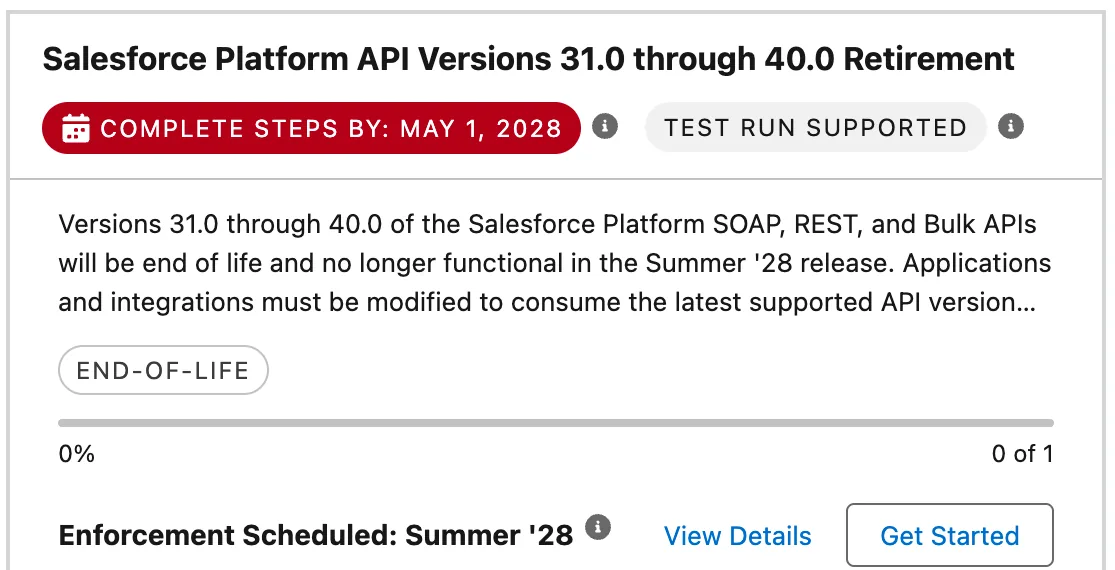
A focus retirement, two releases away, already in the org’s list (Salesforce, Setup in a Developer Edition org, screenshot, November 2026). Full size
What the List Teaches
Section titled “What the List Teaches”Put the three tables together, and a few things stand out.
Most of the ends are recent, and most are still ahead. Of everything in this module, most ended in the last few years or have a date in the next year. If you work on Salesforce integrations in 2026 and 2027, retirement is part of the job.
The reasons are different, and so is the urgency. A security retirement often comes with a short window and a hard stop. A focus retirement gives years of notice. Read the reason; it tells you how much room you have.
Almost nothing ends without warning. Every Salesforce row here was announced well ahead, in release notes, release updates and Help articles. Salesforce keeps one list of what’s retiring and when (Salesforce Active Product & Feature Retirements (opens in a new tab)). The risk isn’t surprise. It’s not looking.
The Whole Timeline
Section titled “The Whole Timeline”Here’s every layer at once. Look at where the red marks are: a few far back, and then a cluster just past today. Look at the amber, too: most of it is in Salesforce’s own layers, things that still work but aren’t where Salesforce is going. And look at the empty layer at the bottom. That’s the next part of the story.
Test knowledge. Know what’s retiring and what replaces it: the username-password and user-agent flows (February 20, 2027), SOAP
login()(Summer ‘27), connected apps (end of support Summer ‘27, replaced by External Client Apps), legacy named credentials (deprecated, replaced by named and external credentials), Salesforce to Salesforce (end of life), and session IDs in outbound messages (removed). The exam aligns to an earlier release, so it may still ask about some of these as current: answer from the exam’s release, and know today’s direction.
What an Architect Decides Here
Section titled “What an Architect Decides Here”- For each retirement that touches your org: the date, the reason, and the replacement.
- How urgent each one is, from the kind of reason: security first, then the rest.
- Who watches for the next one: someone reads the release notes and Salesforce’s retirements list every release.
- The reason, written down in its own words, in your design record, not paraphrased.
Explore
Section titled “Explore”- Salesforce Active Product & Feature Retirements (opens in a new tab), Salesforce Help (checked 2026-11-26): Salesforce’s own list of what’s retiring, and when.
- Security Keeps Changing: chapter 13, the security retirements told as a story.
- RFC 8996, Deprecating TLS 1.0 and TLS 1.1 (opens in a new tab), IETF, March 2021: a standard explaining its own retirement.
- RFC 2577, FTP Security Considerations (opens in a new tab), IETF, May 1999 (checked 2026-11-26): why plain FTP was on its way out.
- JEP 320: Remove the Java EE and CORBA Modules (opens in a new tab), OpenJDK (checked 2026-11-26): CORBA leaving Java, and why.
- Salesforce-to-Salesforce Retirement (opens in a new tab), Salesforce Help, updated 2026-11-22 (checked 2026-11-26): the dates and the alternatives.
- Migrate Cross-Org Adapter Auth to Named Credentials Before Spring ‘27 (opens in a new tab), Salesforce Help (checked 2026-11-26): the cross-org adapter’s two retirement dates.
- Salesforce Connect (opens in a new tab), Winter ‘27 release notes (checked 2026-11-26): why the legacy sign-in is going.